
When folks around Palm Harbor and Clearwater shop for a new roof, the talk usually starts with what they can see: shingle color, tile profile, a metal look. But one of the most important parts of your roof is the layer nobody sees once the job is done: the roof underlayment.
Underlayment is what stands between the Florida weather and your roof deck when the top layer can’t do the job alone. In this guide we’ll walk through what roof underlayment actually does, how the three main types (felt, synthetic, and peel-and-stick) compare, why it matters so much here in Tampa Bay, and the questions worth asking any roofer before you sign a re-roof contract.
What Does Roof Underlayment Do?
Think of your roof in layers. On top is the roof covering: shingles, tile, or metal. Under that is the underlayment, a sheet material installed directly over the wood roof deck (plywood or OSB). Under the deck is your attic.
Underlayment has a few jobs:
- It’s the backup water barrier. Shingles, tiles, and metal panels shed most of the rain, but wind-driven rain can push water sideways and up under the edges. Underlayment catches what gets past.
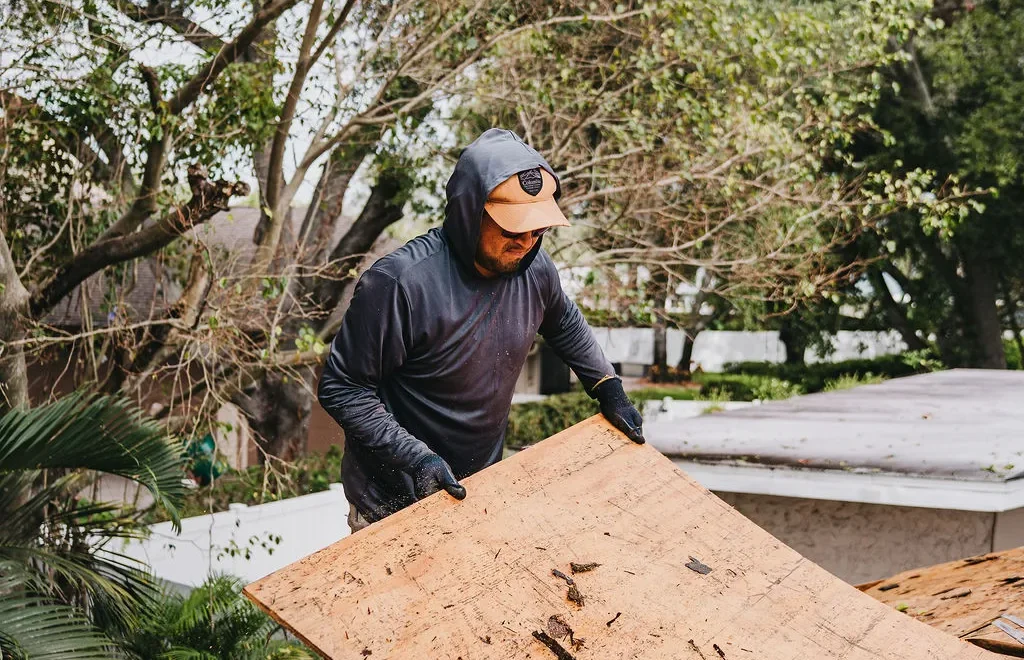
- It protects the deck during installation. Once the old roof is torn off, underlayment goes down quickly so the deck isn’t sitting exposed to an afternoon shower.
- It buys you time when the top layer is damaged. If a storm tears off shingles or cracks tiles, the underlayment is what’s left keeping water out of the house until repairs are made.
Underlayment under shingles, tile, and metal
Every roof type uses underlayment, but how much it matters varies:
- Shingle roofs: Underlayment sits right under the shingles as a second line of defense.
- Tile roofs: This is where underlayment really earns its keep. Concrete and clay tiles are tough, but they aren’t watertight by themselves. On many tile roofs, the underlayment is doing most of the waterproofing, and it often wears out before the tiles do. That’s why a tile roof that looks fine from the driveway can still leak. (More on that in our tile roof repair guide.)
- Metal roofs: Metal panels sit on top of underlayment that has to handle heat and the condensation that can form under metal.
The Three Main Types of Roof Underlayment
1. Felt underlayment (asphalt-saturated felt)
Felt, sometimes called “tar paper,” is the old standard. It’s a mat saturated with asphalt and comes in different weights, often referred to as #15 and #30 felt.
Pros:
- Long track record and familiar to every roofer
- Usually the lowest material cost
Cons:
- Heavier and can tear more easily, especially when it’s wet or in wind during installation
- Can wrinkle or buckle if it gets wet before the roof covering goes on
2. Synthetic underlayment
Synthetic underlayment is made from woven or spun polymers (like polypropylene or polyethylene). It has largely replaced felt on many shingle re-roofs.
Pros:
- Lighter and stronger than felt, so it resists tearing
- Lies flatter and doesn’t absorb water the way felt can
- Many products are rated to handle more UV exposure than felt (check the specific product’s rating)
Cons:
- Costs more than felt
- Like felt, it’s mechanically fastened, so the fasteners are potential water paths unless they’re installed right
- Products vary a lot, so the specific brand and its installation instructions matter
3. Peel-and-stick (self-adhered) underlayment
Peel-and-stick underlayment is a self-adhering membrane, often a rubberized or polymer-modified asphalt with a sticky back that bonds directly to the roof deck.
Pros:
- Bonds to the deck, so water can’t easily travel underneath it
- Seals around nails driven through it, which helps cut down on leak paths
- Often used in the most leak-prone areas: valleys, eaves, around chimneys, skylights, and other roof penetrations
Cons:
- Highest material cost of the three
- Harder to remove later, since it’s bonded to the deck
- Installation details matter, including how it’s paired with the roof covering above it
Why Roof Underlayment Matters More in Florida
Here in Tampa Bay, our roofs deal with a combination that’s hard on every layer:
- Heat and UV. Attic and roof-deck temperatures run high for much of the year. Underlayment has to hold up under that heat for the life of the roof covering.
- Wind-driven rain. Our summer storms and tropical systems don’t drop rain straight down. They blow it sideways, under shingle tabs and tile edges.
- Hurricanes. When high winds strip off part of a roof covering, the underlayment is suddenly the only thing between the rain and your attic.
That last point is why you’ll hear the term “sealed roof deck.” The Insurance Institute for Business & Home Safety (IBHS), an insurance-industry research group, has tested roofs that lost their shingles and found that a sealed roof deck can reduce water entry into a home by as much as 95% compared with a bare, unsealed deck. IBHS’s FORTIFIED program lists a fully adhered membrane over the deck as one way to seal it.
If you’ve looked into the My Safe Florida Home program, you may have seen “secondary water resistance” listed as one of the roof improvements, described on the program’s site as a self-adhering underlayment that protects against water intrusion if the roof covering is lost. Grant rules and eligibility change, so check mysafeflhome.com for the current requirements. For now, the program is limited to low- and moderate-income homeowners.
Florida’s building code also sets underlayment requirements for new roofs and re-roofs. Those rules have changed over the years, and they depend on your roof type, so this isn’t a do-it-yourself decision. A licensed roofing contractor pulling a permit for your job should be able to tell you exactly which underlayment method your roof needs to meet code.
Synthetic vs. Felt vs. Peel-and-Stick at a Glance
| Felt | Synthetic | Peel-and-stick | |
|---|---|---|---|
| How it’s attached | Fastened | Fastened | Self-adhered to deck |
| Tear resistance | Lower | Higher | High |
| Seals around nails | No | No | Yes |
| Relative cost | Lowest | Middle | Highest |
| Common use | Budget or code-minimum installs, some tile systems | Many shingle and metal re-roofs | Full-deck sealing, valleys, eaves, penetrations |
General comparison only. Performance depends on the specific product, the manufacturer’s instructions, and your roof type.
What to Ask Your Roofer About Underlayment During a Re-Roof
Before you sign, ask a few straightforward questions. A good roofer won’t mind.
- What underlayment are you using, and what brand? Get it in writing on the quote.
- Is it the full deck or just certain areas? Some roofs get peel-and-stick only in valleys and eaves. Others get it across the whole deck.
- Does this underlayment work with my roof covering’s warranty? Shingle and tile manufacturers often have their own requirements. (Our Owens Corning vs. GAF comparison touches on manufacturer warranty systems.)
- What meets Florida code for my roof? Your roofer should explain what the permit requires, not just what’s cheapest.
- Will you inspect the roof deck when the old roof comes off? Rotted or soft decking should be replaced before new underlayment goes down.
- Could this help with my wind mitigation report? Ask your roofer and your insurance agent. (Done Rite doesn’t do wind mitigation inspections in-house; we refer them to a trusted third-party partner.) Our post on wind mitigation inspections explains how that report works.
Signs Your Underlayment May Be Failing
You can’t see underlayment from the ground, but you can spot the symptoms:
- Water stains on ceilings, especially after wind-driven rain
- Leaks on a tile roof where the tiles themselves look fine
If any of that sounds familiar, a professional roof inspection is the next step. Our 15-point inspection covers shingle, tile, and flat roofs, includes photo documentation, and attic inspections are available on request.
Get the Right Roof Underlayment for Your Florida Home
Done Rite Roofing has been serving Pinellas, Pasco, and Hillsborough counties for more than 25 years. We’ll come out, measure your roof by hand, and send you a free, detailed quote by the next morning, with the underlayment spelled out. Call us Mon–Fri, 9am–4pm.


